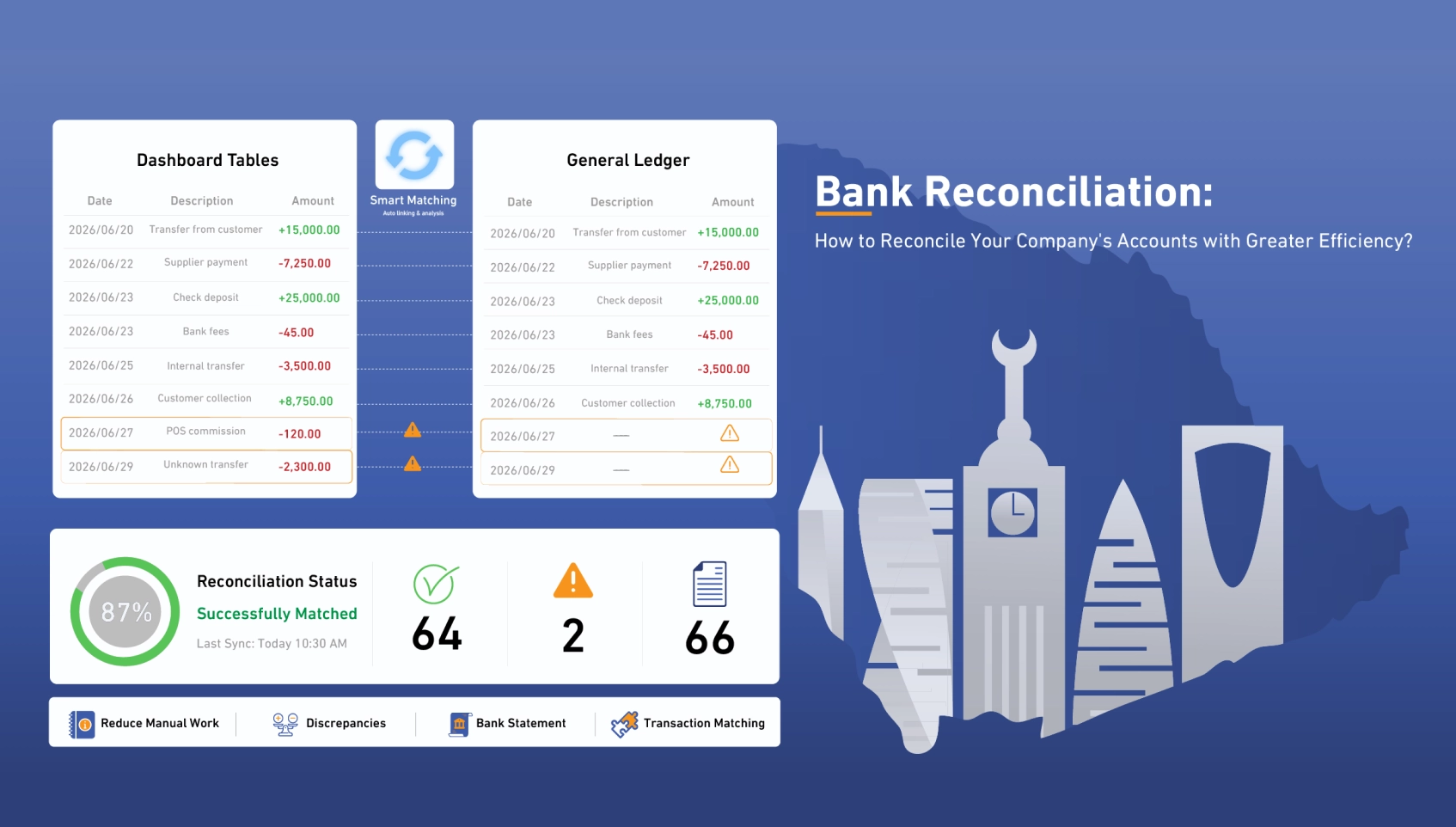
The challenge often arises at the end of the month: the balance on the bank statement does not match the balance in the accounting ledgers, payments have not appeared in the expected sequence, and certain fees or deposits require explanation before closing the accounting period. Here, bank reconciliation becomes an essential step in understanding what actually transpired in a company's accounts.
For a CFO or accounting team, the difficulty lies not in performing the reconciliation once, but in repeating it across multiple banks, multiple accounts, and rapidly changing daily payments. Any delay in reconciliation can directly impact liquidity visibility, reporting accuracy, and management's ability to make timely decisions.
This guide outlines the causes of discrepancies, practical steps for account reconciliation, and when the process becomes more complex for Saudi businesses. It also explores how unified financial visibility can reduce manual effort without sacrificing financial rigor.
In simple terms, bank reconciliation is the process of comparing bank statement transactions against recorded entries in the accounting ledger to identify, explain, and adjust for discrepancies. Its practical value goes beyond a month-end accounting checklist—it provides companies with a far more reliable balance for cash management.
Discrepancies happen primarily because the timing of transaction recording at the bank does not always align with when it is recorded in the internal accounting system. A wire transfer might appear on the bank statement before it is posted to the ledger, an internal invoice might be logged before payment execution, or un-noted bank fees might be deducted automatically.
Other recurring causes include outstanding checks or pending transfers, deposits in transit, manual entry errors, duplicate recordings, or mismatching transaction descriptors between the bank statement and the accounting system. Discrepancies do not always signal major errors, but they require documented explanation before finalizing the official closing balance.
For companies handling high payment volumes, this issue becomes critical. A minor oversight in account matching can lead to inaccurate liquidity forecasts, duplicate vendor payouts, or delays in approving financial reports relied upon by treasury teams for Cash Management.
Successful reconciliation begins with organizing data before diving into analysis. The goal is not a random search for balance differences, but establishing a structured reconciliation process that can be consistently executed monthly or weekly based on transaction volume. A fixed sequence ensures errors are identified faster and more efficiently.
The first step is gathering bank statements for all bank accounts over the target period, verifying start and end dates, as well as opening and closing balances. For multi-bank companies, time periods must be synchronized to avoid comparing a full-month bank statement against partial-month ledger records.
Next begins the process of matching transactions between bank statements and accounting ledgers. Entries are matched by date, amount, description, reference number, or beneficiary. Because transaction descriptions rarely match word-for-word across systems, teams need operational matching rules rather than relying solely on raw bank descriptions.
When a discrepancy appears, it must be categorized before resolution: Is it a bank fee? A pending payout? An unrecorded deposit? An entry error? Or a duplicate entry? Proper classification prevents uniform handling of distinct issues and tells the accounting team which items require journal entries, which require waiting, and which demand internal investigation.
Once discrepancies are explained, adjusting entries are posted to the accounting ledger as needed. These may cover bank service charges, interest, unrecorded operational expenses, or direct deposits. Every entry must be backed by a clear justification rather than forced adjustments aimed solely at balancing figures.
Finance teams can use this simple framework before finalizing reconciliation: Is the data complete? Are matched transactions documented? Are discrepancies properly classified? And are operational errors separated from timing differences?
| Reconciliation Stage | What the Team Reviews | Operational Impact on Decisions |
|---|---|---|
| Data Preparation | Bank statements, ledgers, date range, opening balance | Minimizes comparison errors from the start. |
| Transaction Matching | Amount, date, beneficiary, reference number, description | Accelerates detection of mismatched entries. |
| Discrepancy Classification | Service fees, pending payouts, deposits in transit, entry errors | Prevents posting inaccurate journal entries. |
| Reconciliation Approval | Supporting documents, adjusting entries, concise summary | Elevates report reliability and ensures confident period-end closing. |
Reconciliation increases in complexity as a company scales from a single bank account and modest transaction volume to a matrix of accounts, branches, and payment streams. Here, the challenge is rarely understanding the core concept of bank reconciliation, but rather managing data volume, matching frequency, and the time required to arrive at a dependable balance.
Difficulties escalate when businesses maintain separate operational, payroll, and collection accounts, or process batch payments to numerous suppliers. Each account introduces an additional bank statement, and each internal software names transactions differently—compounding data fragmentation and manual effort.
For instance, a Saudi company operating branches across multiple cities may utilize separate bank accounts for collections, payroll, and vendor disbursements. Reconciling manually across fragmented files reveals that a balance discrepancy exists, but identifying its origin and assessing its impact on cash flow requires significant time and manual labor.
These errors impact more than just accounting entries. When repeated, they cloud liquidity visibility and lead management to make decisions based on partially unverified balances. Companies require a traceable, repeatable matching workflow rather than quick numerical fixes.
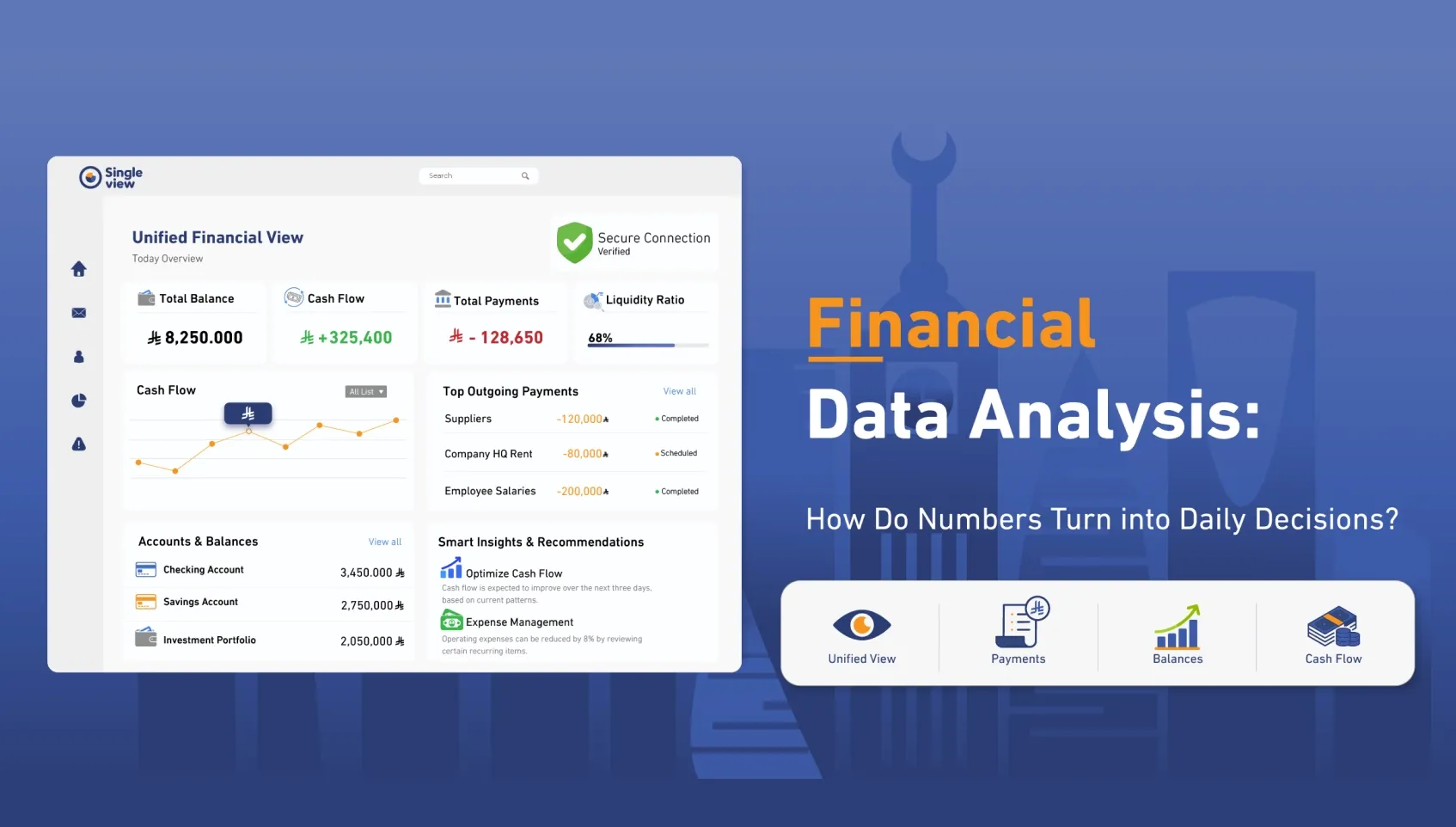
Unified banking data reduces time wasted gathering files before analysis begins. When accounts and transaction streams are consolidated into a single view, finance teams can focus on resolving discrepancies rather than searching for missing statements or reformatting files.
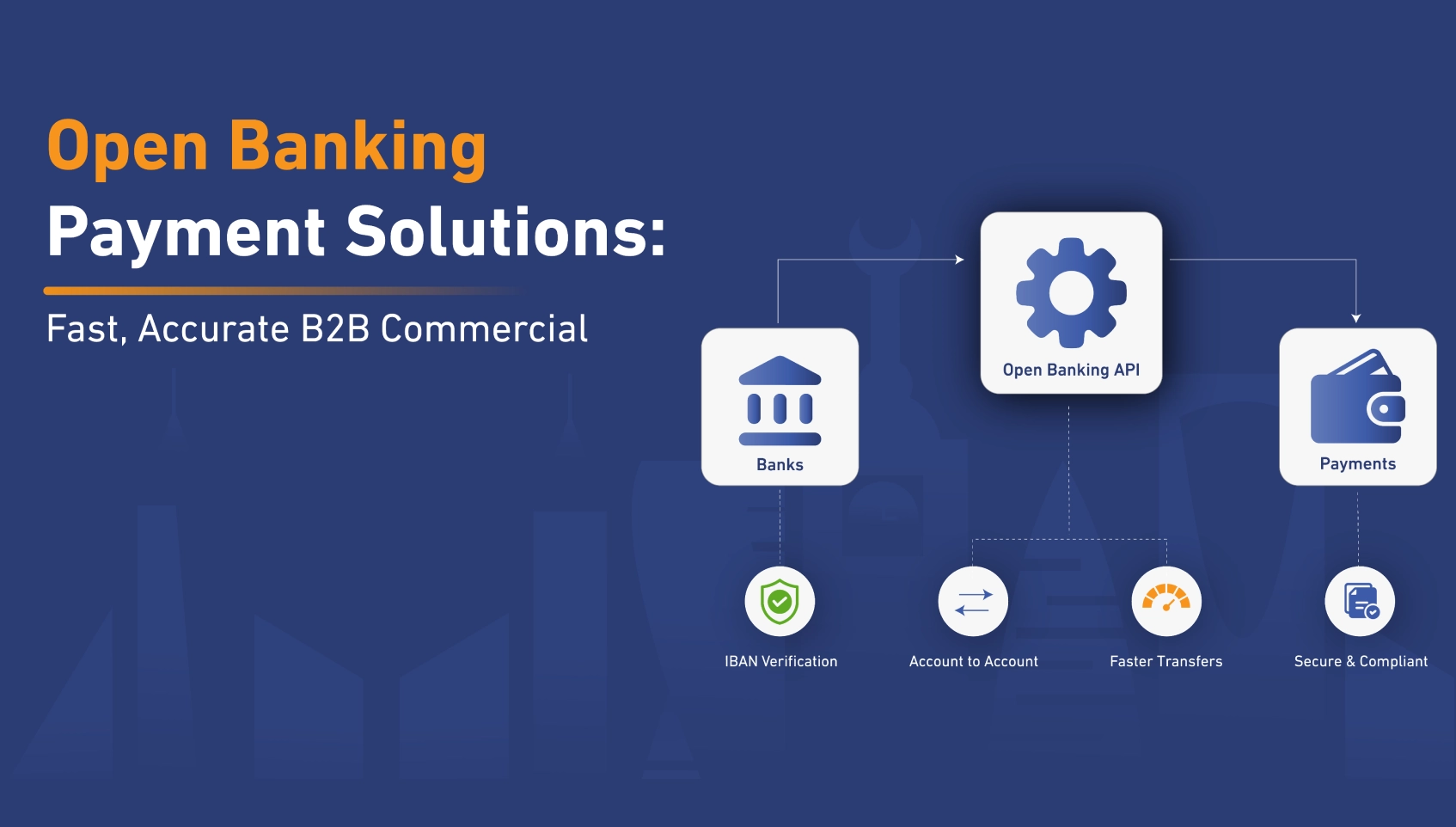
This is where Open Banking provides strategic value. Granted proper authorization, Open Banking standardizes access to multi-bank data, enabling enterprises to build clearer financial visibility. While human review remains necessary, it removes a major portion of manual data preparation prior to matching.
With clear data visibility, CFOs can immediately spot accounts requiring attention, unmatched payouts, and transactions needing additional verification. This directly links bank reconciliation to daily Liquidity Management rather than treating it merely as a month-end compliance task.
SingleView acts as a unifying layer that enables companies to establish clear visibility across accounts and payment flows—especially when managing multi-bank setups or distributed finance teams. The goal is not to displace accountants or auditors, but to reduce fragmentation before matching begins and simplify financial tracking.
Through corporate banking solutions, businesses can manage multiple bank accounts and unified financial visibility in a far more structured way. Additionally, incorporating IBAN verification services ensures beneficiary details are validated prior to payout execution—fostering a cleaner reconciliation process downstream.
If your finance team spends substantial time gathering bank statements or struggling to reconcile ledger-to-bank variances, consolidating banking data access is the essential first step before exploring broader automation.
Before signing off on reconciliation, finance leaders can review this concise checklist to verify process quality:
If multiple items lack clarity, the root issue typically lies in data collection and organization rather than the reconciliation itself. As bank accounts multiply, enhancing unified financial visibility becomes an integral part of reconciliation control.
Bank reconciliation is far more than balancing two numbers at month-end. It is a vital process that clarifies true cash standing, explains discrepancies, ensures precise adjusting entries, and elevates liquidity decisions. As accounts and payment volumes grow, organizing data prior to matching becomes fundamental to operational success.
If your organization manages multiple bank accounts or experiences delays during period-end account matching, achieving unified financial visibility is a practical step toward reducing fragmentation. Explore SingleView solutions to streamline account and payment management, empowering your team with a transparent, efficient reconciliation process.